

Acupuncture for Uterine Receptivity: How It Prepares Your Womb for Pregnancy

If you’re trying to conceive for a while, you probably already know how much effort, planning, and hope can go into every cycle. But here’s something you may not have realised: even the best-quality embryos can fail to implant if your womb isn’t fully ready. It’s not just about the quality of your eggs. It’s equally about how prepared your body is to welcome and nurture an embryo. This critical factor is known as endometrial receptivity (ER). When ER is compromised, even embryos of the highest quality can fail to implant, making pregnancy elusive.
A new review published in Frontiers in Physiology in 2025 analysed dozens of studies and shed light on what we as TCM fertility specialists have long recognised: acupuncture may help support uterine receptivity.
What is Uterine Receptivity?
Uterine receptivity – often termed endometrial receptivity – is the state in which the lining of your uterus (the endometrium) undergoes carefully timed changes to allow a blastocyst (early embryo) to attach and begin to implant into the uterine tissue. It’s the brief window when the uterus is ready for implantation.
Just like planting a seedling best works in spring, your uterus has a short “planting season” each month when everything is perfectly balanced for the embryo to stick and start growing. Only when uterus is ready and ready at precisely right time, the embryo can attach to it and begin the amazing journey of growing into a baby.
How Acupuncture Supports Uterine Receptivity: What the researchers found
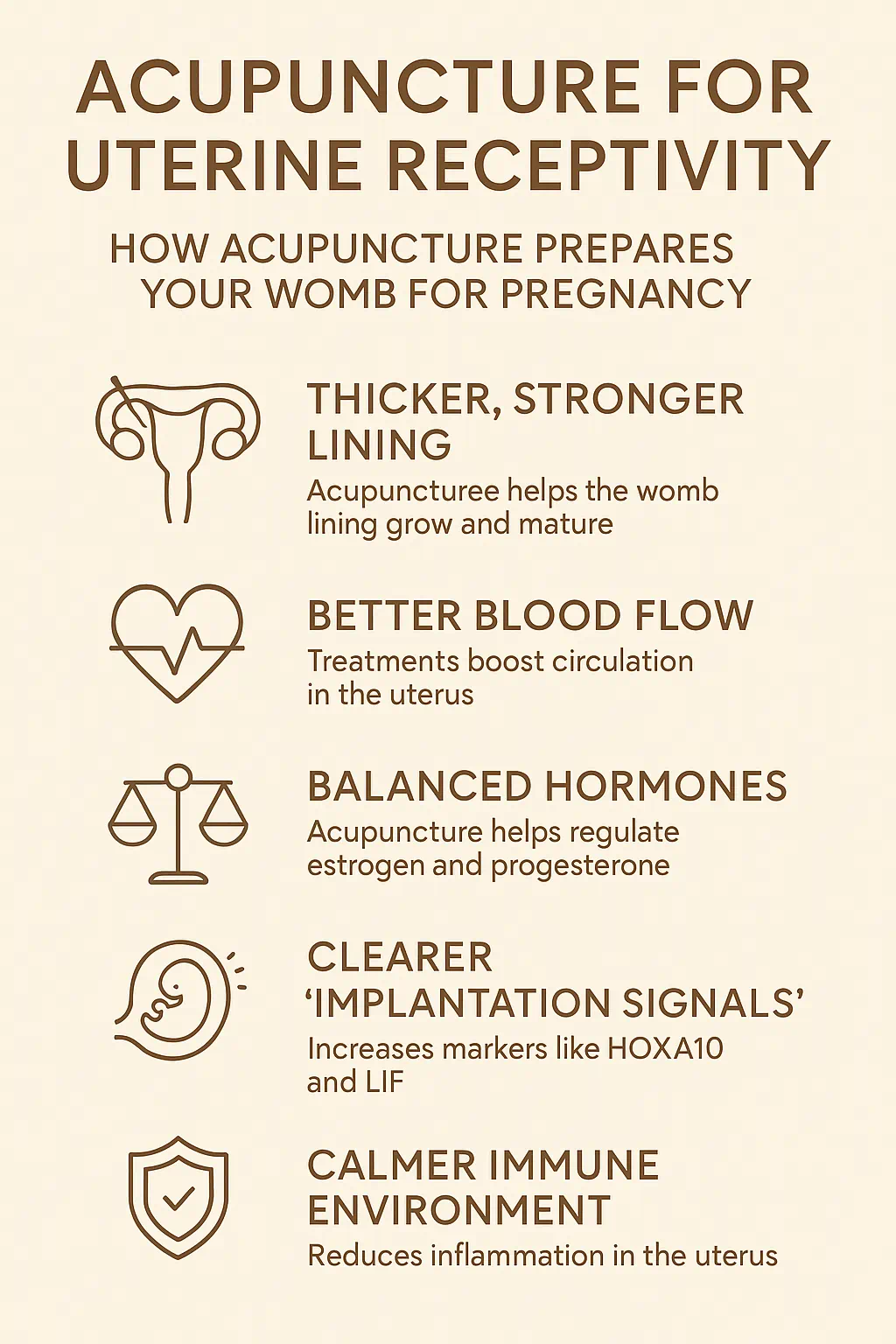
- Thicker, stronger lining: Acupuncture helps the uterine lining grow and mature, making it more welcoming for an embryo.
- Better blood flow: When the blood flow is below a certain level, pregnancy can not happen. Acupuncture treatments boost circulation in the uterus, bringing more oxygen and nutrients exactly where they’re needed.
- Balanced hormones: Acupuncture helps regulate oestrogen and progesterone—two hormones that need to work in harmony each cycle.
- Clearer “implantation signals”: On a microscopic level, acupuncture increases markers like HOXA10 and LIF, tiny molecules that tell your embryo: “Yes, this is the right place to implant.”
- Calmer immune environment: By reducing abdominal/uterine inflammation, acupuncture supports the delicate balance that allows an embryo to stay implanted.
Why this matters
Right now, the average implantation success rate in IVF is only about 25% – meaning three out of four attempts don’t lead to pregnancy. The problem isn’t always with the embryo itself, but often with the uterus not being receptive enough.
Acupuncture stands out because it’s works with your body, not against it. Unlike many medical interventions, it carries minimal side effects – and yet the study hilights it may directly increase implantation, pregnancy, and even live birth rates.
The takeaway
This isn’t about “alternative” therapy anymore – this is about science catching up with what Chinese medicine have known for generations. Acupuncture has measurable, biological effects that could tip the balance in your favour. It has been shown to improve Uterine Receptivity.
And especially if you’re in your mid-30s or beyond, every cycle is precious. The question is – why risk missing out on a therapy that could make all the difference for you?
Acupuncture as an Adjunct Therapy for Enhancing Endometrial Receptivity in Female Infertility: A Literature Review
Authors: Shike Zhang, Hui He, Jingyuan Wang, Li Ma, Xiaoyu Wei, Mingxing Zhang, Yi Guo
Published: 07 August 2025
DOI: 10.3389/fphys.2025.1548737
Journal: Frontiers in Physiology, Volume 16, 2025
Introduction
Infertility remains a global challenge, with female factors accounting for the majority of cases. Endometrial receptivity (ER), the ability of the endometrium to accept and support embryo implantation, is a critical determinant of successful conception. Traditional Chinese medicine, specifically acupuncture, has been widely adopted as an adjunct therapy for enhancing ER and improving reproductive outcomes in infertile women. This literature review explores the efficacy and underlying mechanisms of acupuncture in promoting ER by focusing on key areas, including improvements in endometrial morphology, increasing uterine blood flow, adjustment to hormone levels, regulation of molecular markers, modulating endometrial immune-inflammatory microenvironment, and probably activating the somatosensory-autonomic reflex pathway. Although promising, existing studies on acupuncture and ER often face limitations in sample size and methodological rigor, highlighting the need for larger, high-quality randomized controlled trials (RCT). Furthermore, the safety profile of acupuncture in infertility treatment is favorable, with few reported adverse effects. These findings suggest that acupuncture could be a viable complementary therapy for improving pregnancy outcomes in women with compromised ER, although further research is essential to establish definitive protocols and mechanisms.
Endometrial Receptivity Assessment
To date, various modalities, including endometrial biopsy, ultrasound, endometrial receptivity array (ERA) tests, endometrial fluid aspiration, and hysteroscopy, have been developed to assess ER. Numerous markers have been identified as being closely associated with ER. Among the earliest methods, endometrial histological dating based on Noyes’ criteria provided a classic approach to evaluate the window of implantation (WOI) by defining various morphological stages of endometrial development, including menstrual, proliferative, and secretory phases. With advances in medical research, the ERA has emerged as a promising molecular instrument for diagnosing ER. Despite progress, accurately diagnosing ER remains a challenge due to the lack of a reliable, non-invasive, and clinically applicable test.
Factors of Defective Endometrial Receptivity
The contributing factors that cause defective ER may not yet be fully recognized, but the causes are multifactorial and include endocrine disorders (such as polycystic ovary syndrome [PCOS]), thin endometrium, uterine anomalies (such as leiomyomas, polyps, adenomyosis, septa), chronic endometritis (CE), and immunologically mediated disturbances. The review details each factor and its impact on ER defects.
Acupuncture’s Role in Treating Endometrial Receptivity
Acupuncture has been used for centuries in China to regulate the female reproductive system, with modern clinical and animal studies supporting its use for improving ER and pregnancy outcomes. Acupuncture is widely used as an adjuvant therapy in female infertility, especially for PCOS and assisted reproductive technologies.
Clinical Efficacy
Multiple studies show that acupuncture, electroacupuncture (EA), and transcutaneous electrical acupoint stimulation (TEAS) can improve ovulation rate, embryo implantation rate, clinical pregnancy rate, live birth rate, EMT, and morphology compared to medication, sham acupuncture, or physiotherapy. Some trials find no clinical pregnancy improvement, but most note improved endometrial conditions.
Animal Studies
Animal models confirm that acupuncture and EA can modulate hormone levels, enhance endometrial thickness, support endometrial morphology, boost angiogenesis, and modulate immune function, leading to improved receptivity and pregnancy outcomes.
Efficacy and Mechanisms of Acupuncture in Improving Endometrial Receptivity Among Infertile Women
Improving Endometrial Morphology
Acupuncture can increase endometrial thickness and the rate of optimal (Type A) endometrial patterns, supporting better embryo implantation outcomes. The review summarizes studies showing acupuncture raises the proportion of Type A endometrial pattern and enhances pinopodes expressions on the endometrium.
Enhancing Endometrial Blood Flow
Acupuncture may improve uterine and endometrial blood supply by reducing arterial resistance indices, increasing vascular indices, and promoting a more receptive microenvironment. It also reduces serum markers of thrombosis and improves microcirculation to support embryo implantation